Giovanni Battista Pittoni (1687–1767), The Handing Over of the Keys to Peter
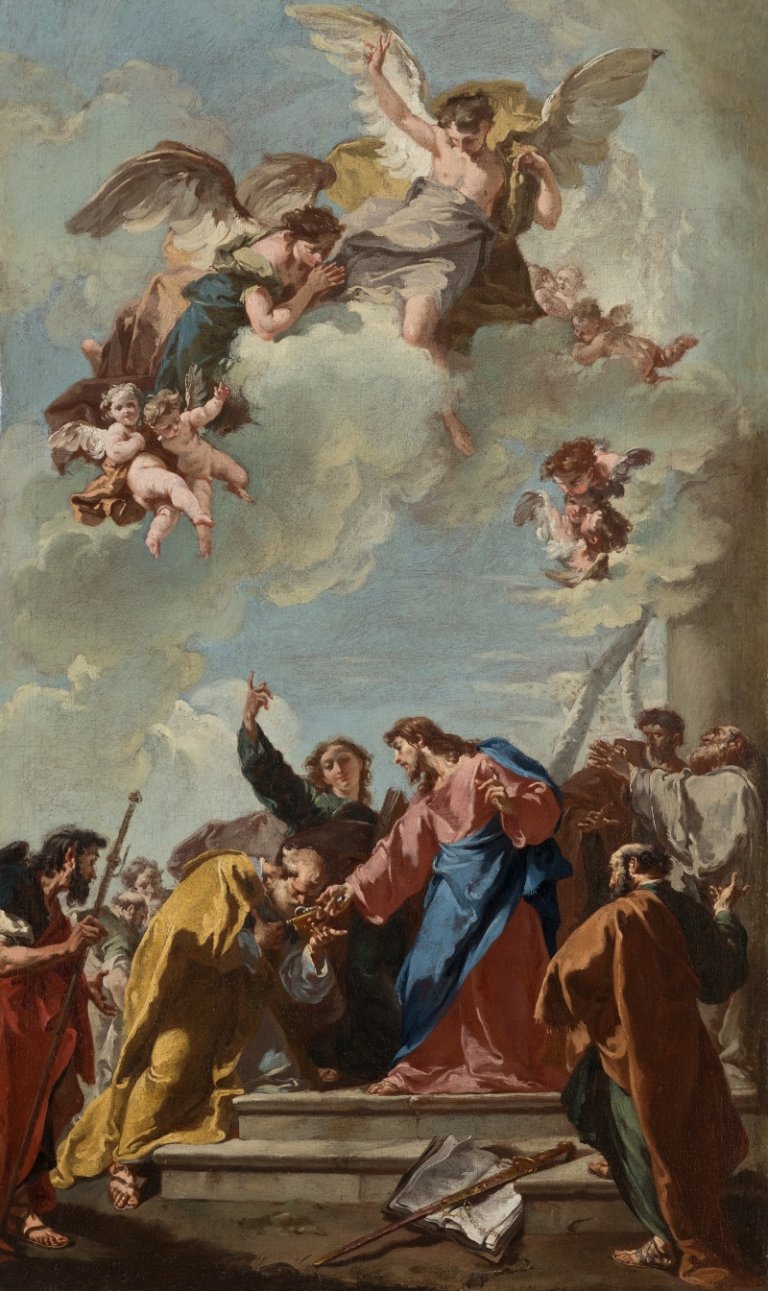
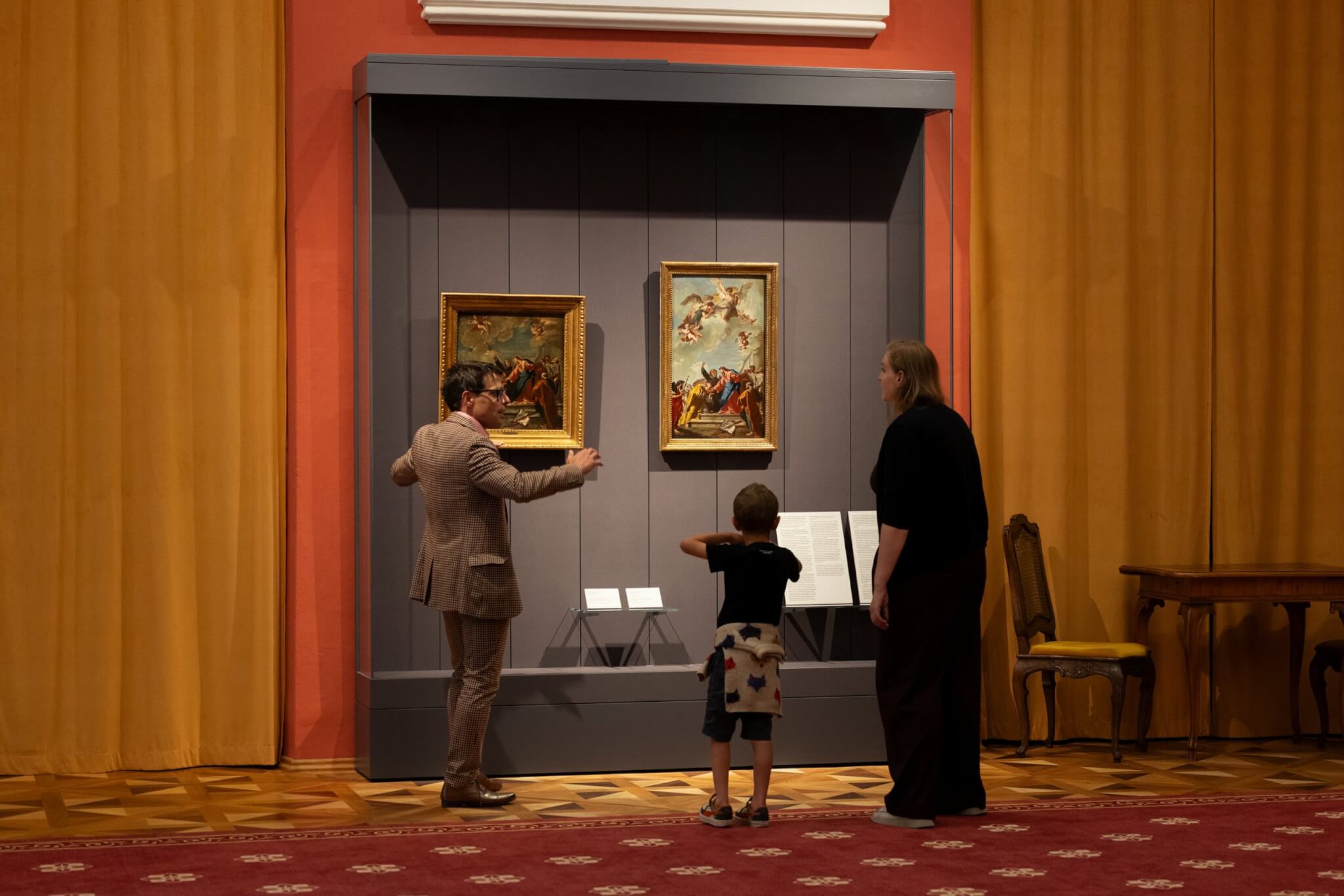
As part of the “A Glimpse into the Storage” series, visitors to the Archbishop’s Castle in Kroměříž can view a work of art that was generously donated last year to the Olomouc Museum of Art by Helena Neumannová, daughter of the prominent Czech art historian Jaromír Neumann (1924–2001), in whose collection the painting was previously held. The nearly 300-year-old painting is now in excellent condition thanks to the work of museum conservator Anna Pišťková in 2025–2026.
The Handing Over of the Keys to Peter, also known as The Commissioning of Peter by Christ, was painted around 1735 by the Italian painter Giovanni Battista Pittoni (1687–1767), one of the leading figures of the Venetian Rococo. He gained recognition during his lifetime not only in the Venetian region but also in Central Europe, where he was among the most sought-after artists. He also played a role in founding the Academy of Fine Arts in Venice, where he served as president for many years and taught as a professor until his death.
“You are Peter; you are the rock on which I will build my church (…) I will give you the keys to the kingdom of heaven.”
A quotation from the Gospel according to St. Matthew (16:18–20), which serves as the inspiration for the painting. Christ’s metaphorical speech was regarded as the prototype of the sacrament of Holy Orders.
The work depicts Christ elevating St. Peter to the position of first among the apostles. Christ stands on a staircase in the center of the composition and leans toward Peter, who kneels to receive the symbolic keys with which he is to lead the Church. The tools for fulfilling this mission—an open book and a sword—lie on the ground, while angels appear among the clouds in the distance. On the left is St. James, depicted with a pilgrim’s staff. With a gesture of his right hand, St. John emphasizes the spiritual significance of the handing over of the keys to the heavenly paradise. The focused expressions on their faces reveal the inner emotion of the other apostles who are witnessing the scene.
Louvre, Tours, Oxford a Olomouc
The painting on display belongs to a group of works that are nearly identical in composition and quality and of the same dimensions, examples of which are preserved, for instance, in the collections of the Louvre in Paris, the Museum of Fine Arts in Tours, and the Ashmolean Museum in Oxford. These examples, along with the painting from the Olomouc Museum of Art, are among the works created in Pittoni’s studio under the master’s supervision. The painting in the Louvre is considered to be the first sketch (bozzetto) of the altarpiece; however, there are no records of its eventual execution, and it is possible that it was never actually created. Yet, given the outstanding quality of the other variants by the same artist, this may not be the case.
The restoration of the painting revealed an original arch in the upper part of the composition—which had been painted over at a later date—that indicated the type of framing intended for the final work. This discovery only served to confirm the authenticity of the Olomouc example, which, in terms of artistic quality, is fully on par with similar works from the aforementioned collections.
The painting is a typical work by Pittoni, in which he fully embraced the Rococo style of Venetian painting from the first half of the 18th century. The colorful planes, almost devoid of chiaroscuro transitions, divide the space through drapery that—it seems—serves to more clearly distinguish the individual figures. This fresh and nimbly executed painting resembles an oil sketch, a so-called “pseudo-sketch,” which were very popular at the time and enjoyed great interest among collectors. This also explains the greater number of nearly identical copies scattered throughout various collections.
Jaromír Neumann has previously pointed out the influence of this composition by Pittoni in German-speaking countries, which may have been introduced there by Paul Troger (1698–1762) or František Antonín Maulbertsch (1724–1796). According to Neumann, examples of this ideological transmission can be found in the large fresco by Jan Lukáš Kracker in the monastery church in Nová Říše in Moravia, dated to 1765–1767, which was influenced by Maulbertsch, and in the frescoes by Jan Václav Spitzer, Jan Jiří Franck, and Josef Jáchym Redelmeyer in Bohemia. Another example of an interpretation of Pittoni’s The Handing Over of the Keys to St. Peter can be found in an early work by Maulbertsch housed at the Silesian State Museum in Opava.
The Archdiocesan Museum in Olomouc houses what is likely a later copy of this iconic work, which Archbishop Leopold Prečan purchased in 1937 from the Brno antique dealer Vladimír Seidl. Although this painting does not match the artistic quality of Pittoni’s Olomouc version, it offers a remarkable insight into how the original was received by contemporary copyists and followers.
Translated with www.DeepL.com/Translator (free version)