Opening: Discover the drama hidden within Jan Knap’s idyllic paintings
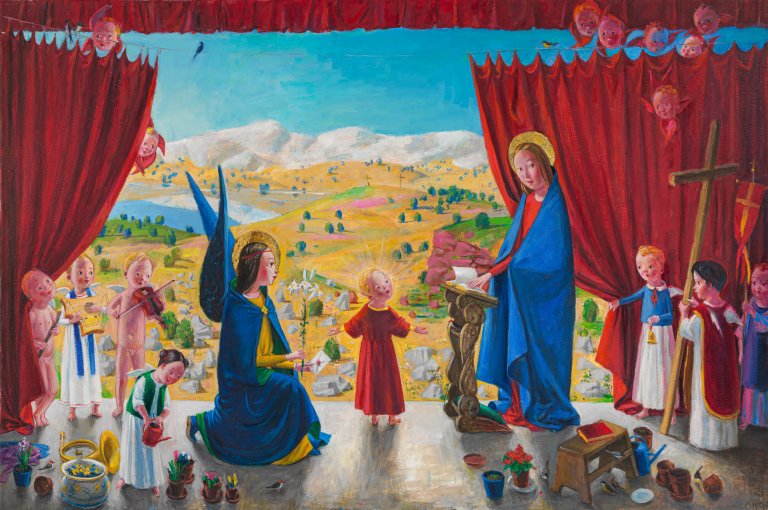
The exhibition is further enriched by works by Old Masters, such as the rare painting Madonna in a Enclosed Garden (1494) by the Master of the Tiburtine Sibyl, on loan from the Diocese of Litoměřice, and Madonna with Animals (after 1503) by a follower of Dürer from the permanent collection of the Archdiocesan Museum. Thanks to this curatorial approach, visitors have the opportunity to directly compare traditional iconographic depictions with the distinctive style of Jan Knap, whose seemingly naive and charming scenes may conceal dramatic elements.
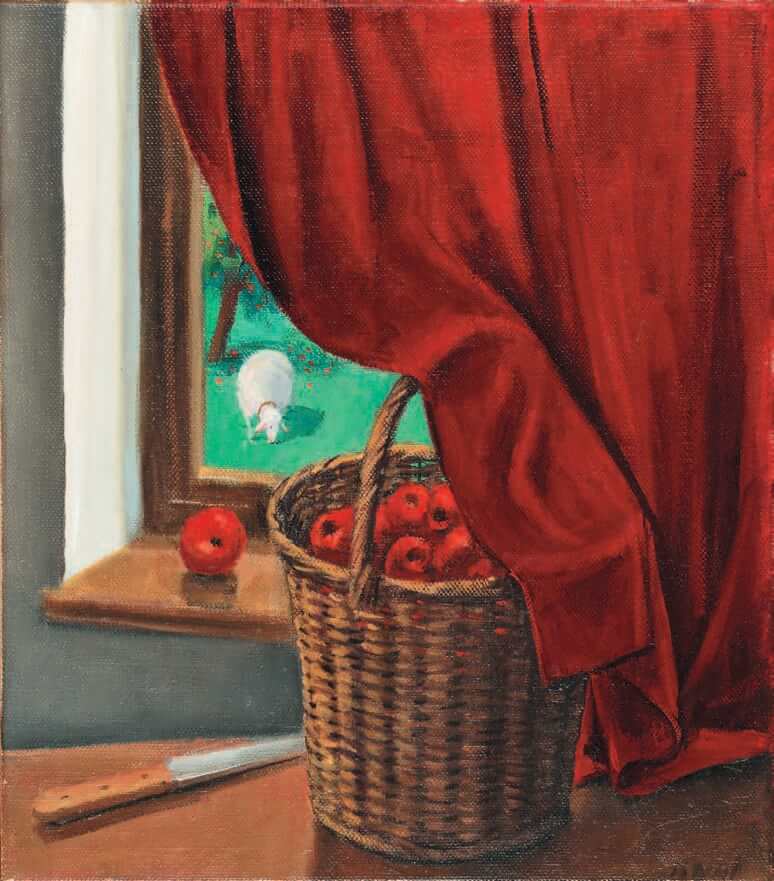
“This is evident, for example, in the painting of a basket of apples. Next to the still life—which reflects Knap’s longstanding interest in Cézanne—lies a knife. At first glance, it is an ordinary object used to cut an apple. However, in the view from the window, we see a grazing sheep in the background—a symbol of innocent sacrifice, as we know it, for example, from the story of the sacrifice of Isaac. This approach can be called meditative iconography: individual motifs are not merely decorative details, but prompts for a slow reading of the painting. It is only through their interrelationships that they reveal the deeper meaning of the entire scene,” explains curator Miriam Kolářová.
The painter Jan Knap (*1949) lives in Planá near Mariánské Lázně in a Gothic house that he restored. After an adventurous escape from Czechoslovakia in 1969, he made his way to Brazil via Hungary and Germany. In the early 1970s, he returned to Germany, where he studied under Gerhard Richter. He later lived in New York, briefly served in the U.S. Marine Corps, spent two years in a Buddhist monastery, and also studied at a theological seminary in Rome. In 1992, he returned to Czechoslovakia with his family. Jan Knap is one of the most internationally successful Czech artists. He has exhibited in renowned galleries in Europe and the U.S., and there is interest in his work in Japan and Taiwan.
“This is evident, for example, in the painting of a basket of apples. Next to the still life—which reflects Knap’s longstanding interest in Cézanne—lies a knife. At first glance, it is an ordinary object used to cut an apple. However, in the view from the window, we see a grazing sheep in the background—a symbol of innocent sacrifice, as we know it, for example, from the story of the sacrifice of Isaac. This approach can be called meditative iconography: individual motifs are not merely decorative details, but prompts for a slow reading of the painting. It is only through their interrelationships that they reveal the deeper meaning of the entire scene,” explains curator Miriam Kolářová.
The painter Jan Knap (*1949) lives in Planá near Mariánské Lázně in a Gothic house that he restored. After an adventurous escape from Czechoslovakia in 1969, he made his way to Brazil via Hungary and Germany. In the early 1970s, he returned to Germany, where he studied under Gerhard Richter. He later lived in New York, briefly served in the U.S. Marine Corps, spent two years in a Buddhist monastery, and also studied at a theological seminary in Rome. In 1992, he returned to Czechoslovakia with his family. Jan Knap is one of the most internationally successful Czech artists. He has exhibited in renowned galleries in Europe and the U.S., and there is interest in his work in Japan and Taiwan.
PUBLICATION AND GUIDE
An accompanying publication featuring a wealth of text and images is being released in conjunction with the exhibition. It includes contributions from experts and friends; early drawings trace the artist’s development, while reproductions of his paintings invite viewers into Paradise and showcase his unmistakable artistic style.
Visitors can use an audio guide during the exhibition, which they can download to their phones via the Cabinet of Wonders app. Thanks to AI technology, visitors can even interact with the electronic guide.
An accompanying publication featuring a wealth of text and images is being released in conjunction with the exhibition. It includes contributions from experts and friends; early drawings trace the artist’s development, while reproductions of his paintings invite viewers into Paradise and showcase his unmistakable artistic style.
Visitors can use an audio guide during the exhibition, which they can download to their phones via the Cabinet of Wonders app. Thanks to AI technology, visitors can even interact with the electronic guide.

Translated with www.DeepL.com/Translator (free version)